


 Download on iOS
How to Identify Depression Glass and What It's Worth
Depression glass is everywhere at thrift stores, but only some of it is worth much. Here is how to identify real pieces, avoid reproductions and price them from actual sales.
Quick answer: Depression glass is colorful, machine-pressed glassware made in the United States and Canada, mostly between 1929 and 1939. To identify it, look at the color, the molded pattern and small flaws like bubbles or faint mold lines, then match the pattern in a reference guide. Most pieces sell for modest amounts, while scarce colors, hard-to-find shapes and short-lived patterns bring the most. Check recent sold prices for your exact pattern, color and piece before you buy or sell.
You have probably seen it at every thrift store and estate sale: a pink plate with a floral pattern, a green sherbet dish, a cobalt blue pitcher. Some of it is common. Some of it is a reproduction. A few pieces are worth real money. Here is how to tell the difference.
What Depression glass is
Depression glass is inexpensive tableware that factories pressed by machine in huge numbers. Most of it came from glass plants in the Ohio River Valley, where raw materials and power were cheap. More than twenty companies made over 100 patterns, including Anchor Hocking, Hazel-Atlas, Federal, Indiana, Jeannette, Macbeth-Evans and U.S. Glass.
It was cheap on purpose. Stores sold it for very little, food companies like Quaker Oats tucked pieces into packages, and movie theaters and other businesses gave it away to bring in customers. That is why so much of it survived, and why so much of it still turns up today.
Collectors also talk about "Elegant glass." That is the finer, often hand-finished glassware sold in department and jewelry stores by makers like Cambridge, Fostoria, Heisey, Fenton and Tiffin. It overlaps with the same era but is a separate category, and it usually sells to a different crowd.
How to identify Depression glass
Start with these checks. No single one proves a piece is real, but together they narrow it down fast.
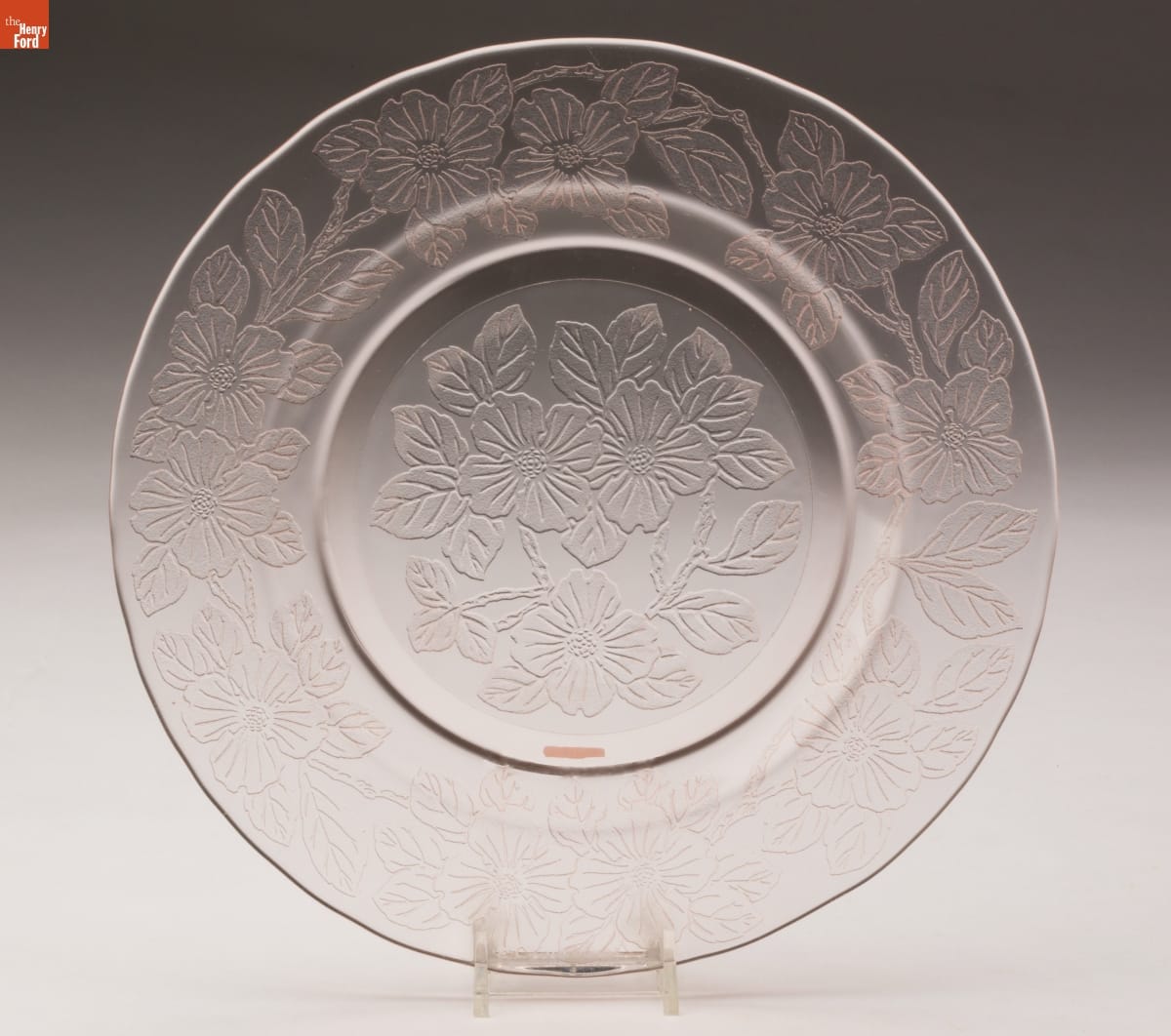
- Color. The most common colors are crystal (clear), pink, green, amber and pale blue. Less common colors include canary yellow, cobalt blue, ruby red, amethyst, black and opaque colors like jadeite (pale green), delphite (pale blue) and monax (white).
- A molded pattern. Most pieces have a pattern pressed into the glass, such as flowers, fruit, lace edges or geometric blocks. Popular names include Cherry Blossom, Mayfair "Open Rose," Royal Lace, Cameo "Ballerina," Miss America and American Sweetheart.
- Small manufacturing flaws. Because it was fast, cheap production, genuine pieces often show tiny bubbles, slight color differences and faint mold lines or mismatches. Collectors accept these. A piece that looks too perfect deserves a closer look.
- A black light test. Some Depression glass contains uranium and glows bright green under a UV flashlight. Yellow and green pieces are the most likely to glow. A glow is a helpful clue, but plenty of real Depression glass does not glow at all.
- No maker's mark. Most Depression glass is unmarked. You identify it by pattern and color, not a stamp on the bottom.
Once you have a pattern in mind, confirm it with a trusted reference. Collectors lean on books like the Collector's Encyclopedia of Depression Glass and Warman's Depression Glass Handbook, and the National Depression Glass Association website has detailed articles on individual patterns. If you just want a fast first guess, you can snap a photo with Moe to get a likely match and a current market value, then double-check the details in a guide.
How to spot reproductions
Popular patterns have been copied for decades, and new copies keep appearing. Reproductions are the biggest trap for new buyers. A few patterns to be careful with:
- Cameo. Salt and pepper shakers are the piece most often reproduced. According to the National Depression Glass Association, the copies have a very faint pattern and too much glass in the bottom, so they hold only about half as much salt as the originals.
- Cherry Blossom. Many companies have reproduced it, in several colors, including iridized finishes.
- Avocado, Sandwich, Miss America and Sharon. All have been remade in newer runs, sometimes in colors the original factories never produced.
- Madrid. It was reissued as "Recollections," also in colors that were not part of the original line.
The general rules: a color that was never made in that pattern is a red flag. So is crisp, heavy glass with a weak, blurry design. Children's dish sets deserve extra care too. For example, Hocking never made Cameo children's dishes, so miniature Cameo pieces are later replicas. When you are unsure, compare the piece side by side with photos of a confirmed original from a reference guide.
What makes Depression glass valuable
Most Depression glass is affordable. Collectors have been buying it since the 1960s, and common pieces are still easy to find. Value comes from a few specific things.
- Pattern. Some patterns had short production runs. In general, the shorter-lived the design, the fewer pieces exist and the more collectors pay.
- Color within the pattern. A pattern can be common in one color and scarce in another. Cameo is a good example. Green is the most common Cameo color, yellow was made for only a couple of years, and pink is the scarcest and most expensive.
- The specific piece. Plates, cups and sherbets were made in huge numbers. Butter dishes, cookie jars, pitchers, cream soups, candy dishes and unusual serving pieces are harder to find. The National Depression Glass Association reports one sale of a rare Cameo center-handled sandwich server at $7,700, which shows how far a single scarce shape can go.
- Condition. Chips, cracks, heavy scratches and cloudy "sick glass" all cut value sharply. Small bubbles and mold lines from the factory do not.
- Sets. A matching set in one pattern and color can sell well, especially to buyers trying to complete a table setting.
Opaque colors have their own following. Jadeite is a big category, and Fire-King is the best-known name for it.
How to check what your piece is worth
Asking prices on listings tell you what sellers hope to get. Sold prices tell you what buyers actually paid. Always use sold prices.
- Name it exactly. Write down the pattern, color, piece type and size. "Pink Cherry Blossom 9-inch dinner plate" gets you far better comparisons than "pink depression glass plate."
- Search sold listings. On eBay, search your exact description and turn on the Sold Items filter. Look at several recent sales, not just the highest one.
- Match condition. Compare your piece only to sales in similar condition. A chipped rim can drop the value to a fraction of a clean example.
- Watch for reproductions in the results. Some sold listings are actually reproductions. Skip those so they do not drag your number down, or push it up.
- Check a price guide for context. Printed guides help you see which pieces in a pattern are considered scarce, even if their dollar figures are out of date.
If you are pricing a whole box from an estate sale, sort it by pattern first. You will often find one or two pieces worth listing alone, with the rest better sold as a lot.
Where to sell Depression glass
- eBay. The largest audience of collectors searching by pattern name. Good for scarce pieces and complete sets.
- Etsy. A popular spot for vintage tableware and home decor buyers.
- Facebook Marketplace. Best for large sets and heavy pieces you would rather not ship. Local pickup avoids breakage.
- Mercari. A simple option for single pieces and small lots.
- Antique malls and dealers. Faster than listing online, though you will usually get less than retail.
Listing the same piece on several sites gets it in front of more buyers. A cross-listing tool like Moe lets you post once to multiple marketplaces and keep buyer messages in one place, which helps when you have a lot of glass to move.
Tips for buying and selling
- Run your finger around every rim. Small chips are easy to miss by eye and are the most common value killer.
- Carry a small UV flashlight. It is a quick, cheap screening tool at thrift stores and estate sales.
- Photograph the pattern clearly. Buyers search by pattern name, so close-ups of the design and an accurate title help your listing get found.
- Pack glass like it is fragile, because it is. Wrap each piece separately, double box anything valuable and fill every gap.
- Know the neighbors. Thrift shelves that hold Depression glass often hold vintage Pyrex too. Our guides to which Pyrex patterns are worth money and what to look for at thrift stores cover what else to grab.
Frequently asked questions
How can you tell if glass is real Depression glass?
Look for a molded pattern, a typical Depression-era color and small factory flaws like tiny bubbles or faint mold lines. Then match the pattern and color in a reference guide. Be suspicious of pieces that look too perfect, have a thick, heavy base or come in a color the pattern was never made in.
What color Depression glass is the most valuable?
It depends on the pattern. A color that is common in one pattern can be rare in another. In general, scarcer colors like cobalt blue, red, black, canary yellow and opaque jadeite or delphite draw more interest than common crystal, pink, green and amber, but the specific pattern and piece matter most.
Does all Depression glass glow under a black light?
No. The bright green glow comes from uranium, which only some pieces contain. Many yellow and green pieces glow, but lots of genuine Depression glass does not. Treat the glow as a clue, not proof.
Is Depression glass marked on the bottom?
Usually not. Most Depression glass has no maker's mark. Collectors identify it by its pattern, color and shape, using reference books or pattern guides.
How much is pink Depression glass worth?
Many common pink pieces sell for modest prices, while scarce shapes in sought-after patterns can bring much more. Value depends on the pattern, the exact piece and the condition. Search recent sold listings for your exact pattern and piece to get a realistic number.
How do you tell Depression glass from a reproduction?
Check whether the color was ever made in that pattern, look for a weak or blurry design, and compare weight and thickness with a confirmed original. Some reproductions, like Cameo salt shakers, have extra-thick bottoms. A reference guide with reproduction notes is the best tool.
Scan it with Moe to get a current value, then list it on multiple marketplaces at once.
Get Moe